Just riffing off your comments regarding your work…

Photography that’s about what you see is fine, but the real stuff for me is all about where you are, and your relationship to the subject matter. The life you live, the voyage you are on, the relationships you can discover when your camera takes you inside, and the rocks you can turn over.

I love looking at the beauty in our views just like anyone else. Patterns, colours, shades, compositions, and the poetry of picture is sweet. But what really turns my crank and ENGAGES me, my heart, my soul and my mind, is what photos can reveal about the photographers life both inner and outer, and the relationships they have with the world around them. The good the bad, the beautiful and the ugly. I suppose its how photography can visualize what is unseen. Below the surface. To be interpreted by the viewer. THe mood, the glance, the look, the bits and pieces of places and times that tell a story.

I suppose ultimately for me, photography is about the story. In this case, your story.

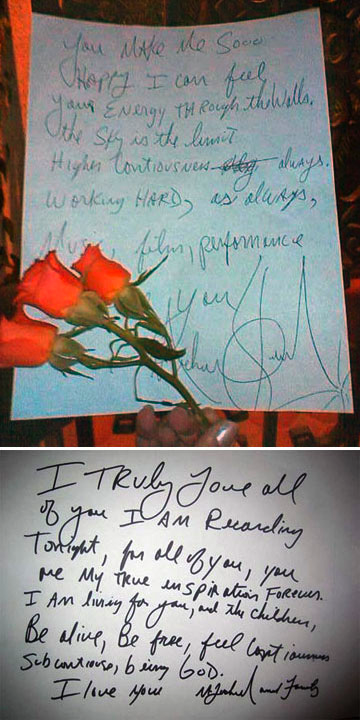
Michael Jackson and his fans

Notes given to his fans in November.


From:Michael Joseph Gross

“The girls would huddle outside the hotel gate that was closest to Jackson’s bungalow, sitting very quietly so that security would not find them. And sometimes Michael would come out and say hello. One time he handed out five handwritten letters that said things like ‘I can feel your energy through the walls. You inspire me so much. I love you all. Thank you for being there. Thank you for being my friend. Thank you for loving me. With all the love in my heart, Michael Jackson.’ I was always impressed by that, how deeply he seemed to care for these girls. When he hugged one of them, he would put one hand on her neck, behind her head, that extra-comforting move like you would do to a person you know. The writing in those letters had a style that was personal, deep, flowery, ornate. It was not ‘Thanks guys. Have a good night. I hope you like the music.’”

This, too, may sound like a sentimental exaggeration, but it is not. I spent a week with the women that Weiss and Evenstad are talking about, while researching Starstruck, a book I wrote about relationships between celebrities and fans. No star was more generous to fans (every member of the core group of Jackson fans that I met had, at some point, been invited into his house to have dinner or to watch movies and hang out), and no group of fans treated one another with more generosity than these women.

“To figure out who would get the letters that Michael wrote to the group,” Weiss says, “the girls would draw straws. They would write their names on pieces of paper and throw them in my camera bag, and I would reach in and draw names. The girl who got the letter would take it and make photocopies and give them to all of the others.”

From the Chair of UrbanArts Community Arts Council

UrbanArts continues to provide opportunities for youth in our Toronto communities to grow and contribute together; fueled by the energy and passion they bring to the arts.  Over the past few years we have been honoured to witness the extraordinary growth of many young people in our programs and the pride they share in performances, recordings, exhibitions and activities within their communities. Their energy is contagious, while reaching ever-higher levels.  Yet this is still just the beginning of what is possible.

This past year saw considerable change and continued growth for UrbanArts as we welcomed our new Executive Director Marlene McKintosh.  Her passionate commitment to the organization, and the outstanding contributions of our talented and fully dedicated staff, has been critical to our ongoing success.   UrbanArts continues to receive increased sustainable support from different areas, as a sense of place for our organization and our youth is becoming more and more evident.  Our networks shared with community partners, artists, government and donors are strengthening and diversifying as we respond to the needs of our neighbourhoods during these turbulent times.

We cannot thank those who have contributed and supported UrbanArts enough. From our diligent board members, to our remarkable staff and volunteers, and on to the families within the community; every effort large and small is appreciated.   All of our partnerships including the TCHC, For Youth Initiative (FYI), Frontlines Youth Centre and North York Community House’s Community on the Move; and our funders such as the City of Toronto, the Youth Challenge Fund, and the Ontario Trillium Foundation are essential contributors to our continued service in our communities.

And most importantly, to the youth of our communities we say a most heartfelt thank you!  For you are the very lifeblood of UrbanArts.  Your presence, energy, determination and partnership are our collective future.  Ultimately, you are UrbanArts.

Thank you all.  Please stay with us as we continue to build a fresh sense of ‘new possibility’ through the engagement of our youth in the arts right here where we all live.  Right here at UrbanArts.  Here, in our communities.

How to be remarkable

Seth’s Blog: How to be remarkable

1. Understand the urgency of the situation. Half-measures simply won’t do. The only way to grow is to abandon your strategy of doing what you did yesterday, but better. Commit.

2. Remarkable doesn’t mean remarkable to you. It means remarkable to me. Am I going to make a remark about it? If not, then you’re average, and average is for losers.

3. Being noticed is not the same as being remarkable. Running down the street naked will get you noticed, but it won’t accomplish much. It’s easy to pull off a stunt, but not useful.

4. Extremism in the pursuit of remarkability is no sin. In fact, it’s practically a requirement. People in first place, those considered the best in the world, these are the folks that get what they want. Rock stars have groupies because they’re stars, not because they’re good looking.

5. Remarkability lies in the edges. The biggest, fastest, slowest, richest, easiest, most difficult. It doesn’t always matter which edge, more that you’re at (or beyond) the edge.

6. Not everyone appreciates your efforts to be remarkable. In fact, most people don’t. So what? Most people are ostriches, heads in the sand, unable to help you anyway. Your goal isn’t to please everyone. Your goal is to please those that actually speak up, spread the word, buy new things or hire the talented.

7. If it’s in a manual, if it’s the accepted wisdom, if you can find it in a Dummies book, then guess what? It’s boring, not remarkable. Part of what it takes to do something remarkable is to do something first and best. Roger Bannister was remarkable. The next guy, the guy who broke Bannister’s record wasn’t. He was just faster … but it doesn’t matter.

8. It’s not really as frightening as it seems. They keep the masses in line by threatening them (us) with all manner of horrible outcomes if we dare to step out of line. But who loses their jobs at the mass layoffs? Who has trouble finding a new gig? Not the remarkable minority, that’s for sure.

9. If you put it on a T-shirt, would people wear it? No use being remarkable at something that people don’t care about. Not ALL people, mind you, just a few. A few people insanely focused on what you do is far far better than thousands of people who might be mildly interested, right?

10. What’s fashionable soon becomes unfashionable. While you might be remarkable for a time, if you don’t reinvest and reinvent, you won’t be for long. Instead of resting on your laurels, you must commit to being remarkable again quite soon.

Posted by Seth Godin on January 07, 2007 | Permalink