
Al Gore Climate update

building community by any means imaginable

Photography that’s about what you see is fine, but the real stuff for me is all about where you are, and your relationship to the subject matter. The life you live, the voyage you are on, the relationships you can discover when your camera takes you inside, and the rocks you can turn over.
I love looking at the beauty in our views just like anyone else. Patterns, colours, shades, compositions, and the poetry of picture is sweet. But what really turns my crank and ENGAGES me, my heart, my soul and my mind, is what photos can reveal about the photographers life both inner and outer, and the relationships they have with the world around them. The good the bad, the beautiful and the ugly. I suppose its how photography can visualize what is unseen. Below the surface. To be interpreted by the viewer. THe mood, the glance, the look, the bits and pieces of places and times that tell a story.
I suppose ultimately for me, photography is about the story. In this case, your story.


Home – BIXI System

BIXI is the new bikestyle, truly a means of transport unto itself. It’s the bike you take whenever you want and leave behind when you reach your destination. It’s BIXI – now you’ve got wheels.
The RoboScooter is a lightweight, folding, electric motor scooter. It is designed to provide convenient, inexpensive mobility in urban areas.

Illustrator and conceptual thinker Norio Fujikawa gets full-marks for this radical Jetscooter concept. Based in San Fransisco the designer has a penchant for futuristic ideas, with retro styling, and transport innovation that might become a reality in, say 2025. Until then we can only marvel and this creative genius.
“This is the PEN Story in stop motion. We shot 60.000 pictures, developed 9.600 prints and shot over 1.800 pictures again. No post production! Thanks to all the stop motion artists who inspired us. We hope you enjoy :-)”
Notes given to his fans in November.
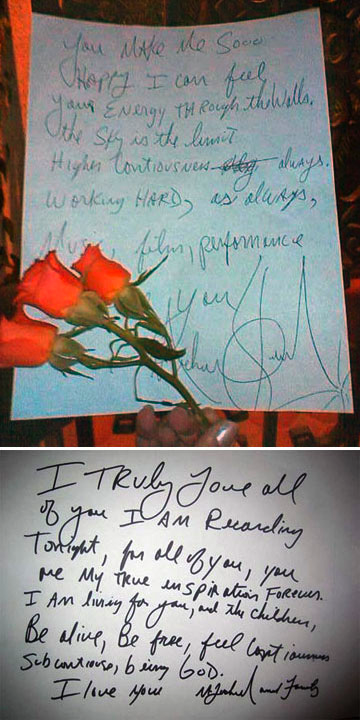
From:Michael Joseph Gross
“The girls would huddle outside the hotel gate that was closest to Jackson’s bungalow, sitting very quietly so that security would not find them. And sometimes Michael would come out and say hello. One time he handed out five handwritten letters that said things like ‘I can feel your energy through the walls. You inspire me so much. I love you all. Thank you for being there. Thank you for being my friend. Thank you for loving me. With all the love in my heart, Michael Jackson.’ I was always impressed by that, how deeply he seemed to care for these girls. When he hugged one of them, he would put one hand on her neck, behind her head, that extra-comforting move like you would do to a person you know. The writing in those letters had a style that was personal, deep, flowery, ornate. It was not ‘Thanks guys. Have a good night. I hope you like the music.’”
This, too, may sound like a sentimental exaggeration, but it is not. I spent a week with the women that Weiss and Evenstad are talking about, while researching Starstruck, a book I wrote about relationships between celebrities and fans. No star was more generous to fans (every member of the core group of Jackson fans that I met had, at some point, been invited into his house to have dinner or to watch movies and hang out), and no group of fans treated one another with more generosity than these women.
“To figure out who would get the letters that Michael wrote to the group,” Weiss says, “the girls would draw straws. They would write their names on pieces of paper and throw them in my camera bag, and I would reach in and draw names. The girl who got the letter would take it and make photocopies and give them to all of the others.”
